
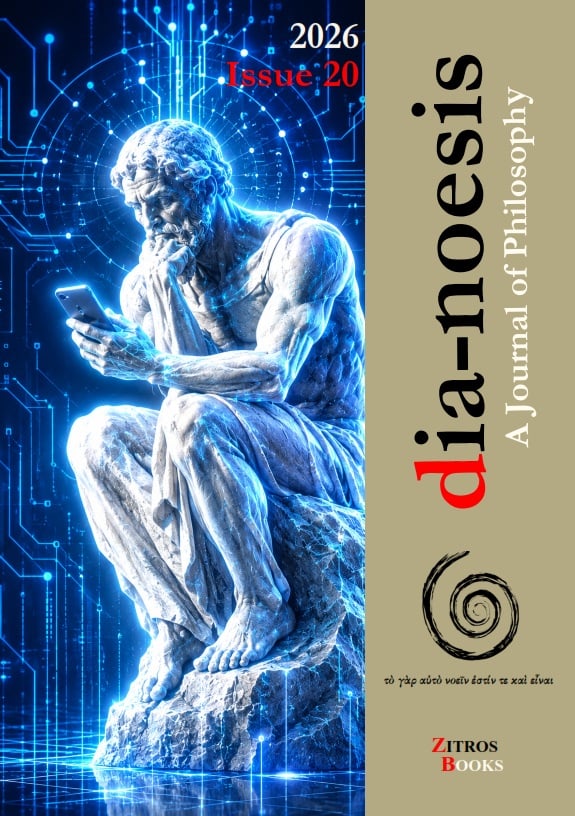
Download full version here.
Articles on Philosophy and Artificial Intelligence
Iryna Aleksandruk – Oleksandra Palchevska – Alina Androshchuck,
Artificial Intelligence and the Death of the Author: Originality, Creativity and Generative Art Ontology, p. 9
Raima Bhaumik – Kekhronguu Dazo,
Cyborg Bodies and Transnational Agenda: Sex Work, Artificial Intelligence, and Governance, p. 35
Basil Osayin Daudu – Salaudin Usman,
Didactics of Human in AI Form, p. 61
Christos A. Koutsotasios – Elias Vavouras,
Hegemonikon and AI, p. 87
Ravi Kumar – Madhu Mangal Chaturvedi – Reena Kumari,
Artificial Intelligence in Pedagogy: Complementarity versus Replacement of Human Educators, p. 115
Ramakrishna Iyer Lekshmi,
Understanding the “Understanding of AI”: Ethical and Political Concerns Arising from Functionalist and Interpretivist Traditions, p. 147
Aikaterini Manoli – Sotiria Triantari – Ioannis Zervas,
Leadership in the Age of AI: Aristotelian Rhetoric and Human-Centered Management, p. 169
Kyriaki Papadopoulou – Stavros Kalogiannidis – Foteini Kagioglou,
Deliberative Democracy vs Automated Ombudsmanship: the Ethical Limits of AI in Public Complaint Mediation, p. 195
Rina Avinash Pitale Puradkar,
Can Machines Think or Realize?: An Ethical and Spiritual Dimension of Artificial Intelligence from Indian and Western Philosophical perspective, p. 217
Raul V. Rodriguez – Naveen Kolloju – Raju Chaketi – Venkatesh Boddu,
Digital Manipulation of Democracy: AI-Driven Psychological Warfare in Electoral Systems, p. 233
Ozlem Derin Saglam,
When The Subject Disintegrates: On Human, Machine, And Relational Ontologies, p. 265
Jaya Sharma,
Echoes of Radha in the Machine: Bhakti Poetics and AI Interpretation through ChatGPT, p. 291
Priya Sharma – Saroj Bala,
The Animal, the Artificial Intelligence, and the Author: The Non-Human Intelligence in Kazuo Ishiguro’s Novel Klara and the Sun, p. 323
Philosophical Notes on Philosophy and Artificial Intelligence
Maria Kollia,
From Technical Capability to Institutional Authority: Human Responsibility Before AI Execution, p. 345
Michael Papademas,
Anthropomorphic Machines without Mortality: Artificial Intelligence, Embodiment, and the Erosion of Philosophical and Democratic Life, p. 371
Ninio Sagucom,
AI As Epistemic Enframing: Heidegger on Calculative Reason, Human Meaning, and the Limits of Algorithmic Knowledge, p. 397
Anujeeth Sajeev,
The Theory of Dia-referentiality: A Dialectical Evolution Beyond Hyperreality, p. 421
Zhang Yiwen,
The Self of No-Self: Yogacara, Consciousness-Transformation, and the Analysis of Selfhood in Generative AI, p. 447
Articles
Ekta Meenia – Smarika Pareek,
Slow Travel, Fast Threats: Gendered Violence and Feminist Ethics in Apurva, p. 475
Nadjiba Bouallegue,
Re-rooting in Time: Exile and the Rhizomatic Framework of Trauma in Lan Cao’s Monkey Bridge, p. 495
Nebojša Romčević,
The Ontological Foundations of Aristotle’s Poetics, p. 517
Shikha Sharma,
Quest to belong: Home as a metaphor to human cognition in Carla Maliandi’s The German Room (2017), p. 527
Philosophical Notes
Eleni Boliaki,
Michail Theodosiadis: Ancient Greek Democracy and American Republicanism, p. 545
Alexander Semenov,
The Symbiosis of Intelligences: The Sdd Methodology, The Utopia of Sovereignty, And the Return of God in The Age Of AI, p. 553